IT Projects & On-Demand Support: Delivered on Time.
Fixed-scope IT project delivery with transparent pricing, structured methodology, and full documentation at handover. From one-time migrations to multi-month transformation programmes.
Scope, ownership, reporting, and handover confirmed before delivery starts.
/ Direct answer
What does IT project support include?
IT project support from BPro Technologies is for defined technology work that needs scope, planning, delivery, and handover. Projects can include Microsoft 365 migrations, Google Workspace changes, SharePoint file setup, Intune deployment, cloud migration, infrastructure refreshes, security remediation, firewall work, and rollout support with dependencies and approvals documented before implementation.
Remote-first delivery across approved business time zones
Documented scope, evidence, reporting, and handover
Free assessment path before any commitment
Service coverage modelIllustrative workflow, not live data
/ Delivery governance
Project Rollout and Scope Governance Model
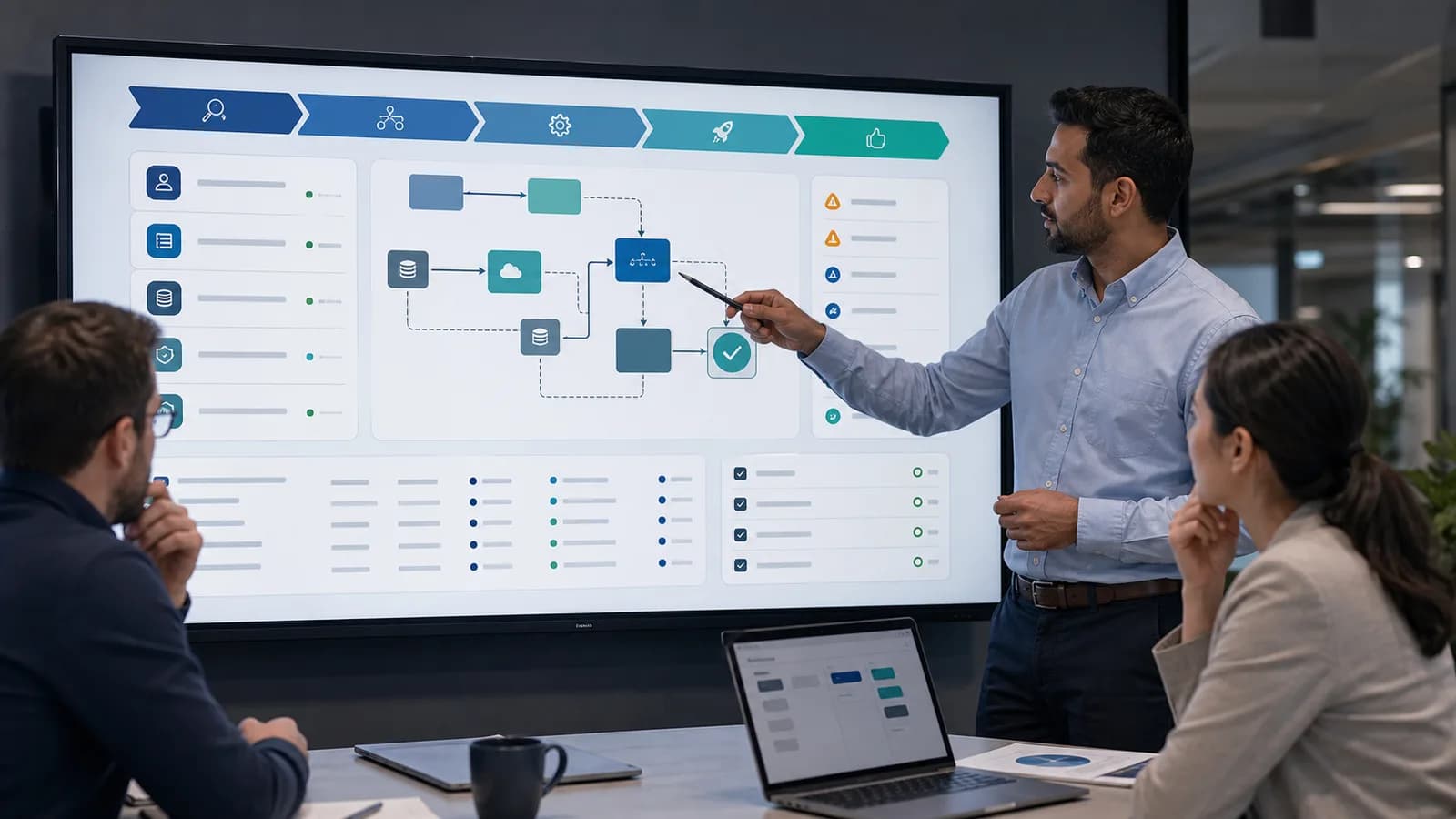
IT projects work best when scope, dependencies, risks, phases, decisions, handover, and post-project support are visible before implementation starts.
Scope blueprint
Rollout path with governance gates
01
Discovery
Business goal, current state, constraints, and decision owners.
02
Scope
Included work, assumptions, exclusions, and acceptance criteria.
03
Dependencies
Vendors, systems, access, data, licensing, and change windows.
04
Phases
Implementation waves, checkpoints, rollback path, and handover gates.
05
Risk log
Open risks, decisions, blockers, owners, and next action dates.
06
Support
Post-project documentation, training notes, and operational ownership.
Decision log
OpenVendor access confirmed
ReviewCutover window selected
ApprovedRollback criteria accepted
Handover pack
Runbook
Ready for operations
Diagram
Ready for operations
Access
Ready for operations
Support
Ready for operations
/ Delivery story
Follow the it projects & on-demand path from scope to launch.
Agree requirements and responsibilities before work starts. Review progress at each stage, test before launch, and leave your team with the documentation needed to run the system.
IT Projects & On-Demand
01
Scope
Scoping & Requirements
We engage key stakeholders, document requirements, define deliverables and explicit out-of-scope boundaries, identify risks, and produce a detailed scope-of-work with a fixed or estimated cost. No work begins until scope is agreed.
02
Build
Project Planning
Detailed project plan with milestone dates, resource allocation, dependency mapping, risk register, and change management procedure. Stakeholder communication cadence is confirmed before kick-off.
03
Launch
Execution & Progress Reporting
Agile-informed delivery with weekly status updates, sprint reviews for longer projects, and transparent progress against milestones. Risks and issues are escalated immediately, with no surprises at the end.
04
Handover
Handover & Close
Full documentation delivery, knowledge transfer sessions with your team or IT staff, post-project review against original objectives, and confirmation of ongoing support arrangements.
/ Proof to review
What proof can buyers inspect before choosing it projects & on-demand?
Buyer-friendly samples and checklists make the delivery model easier to inspect before a call.
Scope blueprint
What will be built, what waits, what can break, and who signs off.
Operating report
Ticket trends, support themes, infrastructure health, and improvement priorities.
Handover packet
Runbooks, diagrams, access notes, configuration records, and escalation paths.
/ Ownership model
How scope is organized
A quieter, inspectable model for what gets reviewed, managed, reported, and handed over.
Planning
Scope, assumptions, risks, technical path, and launch criteria.
Build governance
Weekly checkpoints, change control, and stakeholder review.
Security review
Access, data handling, hosting, backup, and compliance considerations.
Handover
Documentation, training notes, admin access, and support path.
/ Risk matrix
When does IT Projects & On-Demand become urgent?
These are the operational signals that usually mean the risk is no longer theoretical.
High
You need specialist expertise for a one-time project
Your internal team may lack specific experience with a platform, migration, or technology. Hiring a full-time specialist for a short engagement is slow and expensive. On-demand expertise is the smarter option.
Medium
Previous IT projects went over budget or stalled
IT projects most commonly fail due to unclear scope, underestimated complexity, and poor change management. A structured delivery methodology prevents these problems before they start.
Medium
A major platform migration or upgrade is on your roadmap
Moving to Microsoft 365 or Google Workspace, refreshing server infrastructure, migrating to the cloud, or upgrading your network all require careful planning, expert execution, and minimal disruption to daily operations.
Low
You're running legacy systems that create risk and limit growth
End-of-life software, unsupported operating systems, and aging platforms increase security exposure, limit integration options, and make it harder to attract and retain technical staff.
/ Buyer outcomes
What should buyers verify before choosing it projects & on-demand?
A serious it projects & on-demand partner should make scope, ownership, evidence, and handoff visible.
Defined Scope, No Surprises
Every project starts with a detailed scope-of-work document. You know the deliverables, boundaries, timeline, and cost before work begins. Changes go through formal change control.
Built to Last
We engineer for your next 3-5 years, not just the immediate requirement. Architecture decisions consider your growth trajectory, integration roadmap, and operational capacity.
Specialist Engineers on Demand
Access to engineers with deep expertise in specific platforms and technologies, without the recruitment timeline, salary overhead, or retention risk of a full-time hire.
Rapid Time-to-Value
Agile-informed delivery with short feedback loops, regular client checkpoints, and milestone-based progress, so value is realised incrementally, not just at the end.
/ Scope map
What work is included in it projects & on-demand?
The practical work BPro Technologies can own, document, and report for it projects & on-demand.
Project Deliverable Examples
Written scope, migration runbook, risk register, rollback plan, access matrix, configuration notes, test checklist, handover pack, admin guide, and post-project review notes, matched to the project type.
Microsoft 365 & Google Workspace Migration
Full M365 or Google Workspace tenant setup and migration in either direction, including mail migration, Teams or Meet deployment, SharePoint or Drive architecture, OneDrive or Shared Drive rollout, security baseline configuration (MFA, Conditional Access), license assignment, and user training.
Cloud Migration Projects
Structured cloud migration using defined phases: assessment, planning, pilot migration, full migration, and post-migration optimization. Delivered with runbooks, architecture documentation, and a 30-day post-migration support window.
Server Refresh & Data Centre Projects
Planning and execution of server hardware refresh cycles, including data migration, hypervisor upgrades (VMware, Hyper-V), storage consolidation, and cutover strategies designed to eliminate or minimize downtime.
Active Directory & Identity
Active Directory design, implementation, or remediation, including Azure AD join for hybrid identity, Conditional Access policy design, Group Policy architecture, MFA rollout, and AD audit and cleanup for environments with years of accumulated technical debt.
Network Refresh Projects
Switch and firewall replacement, wireless infrastructure upgrade, VLAN redesign, SD-WAN implementation, and network documentation, delivered as a structured project with defined phases, a clear bill of materials, and functional testing before handover.
Security Remediation Projects
Post-assessment security gap remediation: MFA enforcement across all users, EDR deployment, email security layer implementation, backup configuration and testing, firewall rule cleanup, and patching backlog clearance, each delivered as measurable outcomes.
IT Strategy & Technology Roadmap
Multi-year IT strategy development covering technology assessment, gap analysis, prioritised initiative roadmap, vendor evaluation, and budget modelling, to align IT investment with your business objectives over a 1-3 year horizon.
Project Delivery Support
Defined project support for migrations, rollouts, remediation, documentation, and handover without adding permanent headcount or changing the engagement into a hiring model.
/ Engagement terms
Scope, access, and next steps in one place
Clear boundaries help buyers compare it projects & on-demand without assuming every task, license, project, or access path is included by default.
Success criteria, approval path, content or data ownership, integrations, environments, and post-launch support model.
Separate approval
New feature requests, third-party subscriptions, paid media, content production, and scope changes after sign-off.
Access stays approved
We confirm who can approve access, changes, production releases, data movement, and third-party tool connections before work begins.
Scope is written down
The project brief identifies deliverables, dependencies, assumptions, risks, test criteria, handover needs, and the work that requires separate approval.
Share context
Tell us the service area, current tools, users, business impact, and preferred contact window.
Confirm path
We identify the right next step: assessment, project review, co-managed support, or ongoing managed service.
Approve access
Any system access, change window, or implementation work starts only after approval and documented scope.
/ Scope and pricing factors
What affects the right support model?
Pricing is confirmed after scope, systems, access, coverage, and delivery expectations are understood. These factors help buyers compare options without relying on assumptions.
Decision preview
01Project shape
02Technical dependencies
03Support after launch
Project shape
Scope, launch date, integrations, content, data movement, approvals, and handover depth affect the delivery path.
Technical dependencies
Hosting, access, third-party tools, environments, domains, security controls, and existing documentation change the level of work.
Support after launch
Post-launch monitoring, maintenance, reporting, user support, and improvement backlog can be included or handled separately.
Decision needed
A project scope review is usually the best starting point when requirements, risks, or budget approval need structure.
/ Delivery timeline
How We Deliver IT Projects
A delivery path with defined evidence, decisions, and handoff points at every stage.
01
Scoping & Requirements
We engage key stakeholders, document requirements, define deliverables and explicit out-of-scope boundaries, identify risks, and produce a detailed scope-of-work with a fixed or estimated cost. No work begins until scope is agreed.
02
Project Planning
Detailed project plan with milestone dates, resource allocation, dependency mapping, risk register, and change management procedure. Stakeholder communication cadence is confirmed before kick-off.
03
Execution & Progress Reporting
Agile-informed delivery with weekly status updates, sprint reviews for longer projects, and transparent progress against milestones. Risks and issues are escalated immediately, with no surprises at the end.
04
Handover & Close
Full documentation delivery, knowledge transfer sessions with your team or IT staff, post-project review against original objectives, and confirmation of ongoing support arrangements.
/ Buyer scenarios
Who is it projects & on-demand for?
Best-fit teams, environments, and business contexts for this service.
Scenario 01
Enterprise Organizations
Large-scale infrastructure projects, ERP system implementations, data centre consolidations, and digital transformation programmes requiring coordinated delivery across multiple workstreams and stakeholder groups.
Scenario 02
Mid-Market & Growing Businesses
Microsoft 365 migrations, cloud transitions, network upgrades, and technology modernisation for businesses that have outgrown their current setup but don't have in-house capacity to deliver the change.
Scenario 03
Startups Scaling Quickly
Rapid IT setup, cloud-native infrastructure deployment, identity and access management, and technology foundations that grow with you, built for a team that's doubling in size and needs IT that keeps up.
Scenario 04
Businesses with Internal IT Teams
Project support for work that needs extra technical depth: Active Directory design, security remediation, cloud architecture, or a network refresh with defined ownership and handover.
/ Specialist services
Go deeper on a specific job
Detailed pages for the work buyers most often ask about by name.
Scope creep is managed through a detailed scope-of-work document at the start of every project. This defines deliverables, explicit out-of-scope items, assumptions, and dependencies. Any request that extends scope is processed through a formal change control procedure: we document the change, assess its time and cost impact, and get written approval before proceeding. Fixed-fee projects give clients cost certainty within the agreed scope; changes are quoted separately.
Most projects are quoted on a fixed-fee basis after a scoping engagement, so you know the total cost before committing. For projects with higher uncertainty, where requirements may evolve or scope is genuinely hard to define upfront, we can work on a time-and-materials basis with an agreed budget ceiling. We always aim for transparency: no hidden charges, no scope inflation, no ambiguity about what's included.
For on-demand or emergency work, we can typically mobilise within 5 business days of contract execution depending on current workload. Structured projects go through a scoping phase first, which adds 1-2 weeks before delivery begins. If you have a time-sensitive requirement, mention it early and we'll be honest about our availability and whether we can meet your timeline.
Yes. We can manage procurement on your behalf, sourcing hardware and software from our distributor relationships, managing delivery and staging, and ensuring you're receiving competitive pricing. We can also manage existing vendor relationships, review renewal terms, and advise on licensing models. If you prefer to procure directly, we'll provide a detailed bill of materials for you to action.
Every project closes with a formal handover package: final documentation (network diagrams, configuration files, architecture diagrams, or process documents as appropriate to the project type), a knowledge transfer session with your team, a post-project review against original objectives and acceptance criteria, and confirmation of ongoing support arrangements. We don't consider a project complete until your team can operate and maintain the outcome independently.
Yes. On-demand support is billed on a time-and-materials basis: you raise a request, we scope the effort required, you approve, and we execute. There's no minimum task size. For clients who anticipate regular on-demand needs, a monthly retainer of pre-purchased hours provides faster response times and a predictable monthly cost. Retainer terms including hour rollover and response SLAs are agreed at contract level.
A project has a defined start, end, and deliverable, such as a Microsoft 365 migration, a server refresh, or a security remediation. Ongoing managed IT is the continuous monitoring, patching, helpdesk, and security that keeps everything running afterward. Projects are quoted as fixed-scope work; managed IT is a monthly service. Many clients run a project first, then move the result onto a managed plan.
Yes. We deliver standalone, fixed-scope projects with no requirement to sign up for ongoing managed IT. You get the same scoping, documentation, and handover either way. If you later decide you want continuous support, the project documentation makes moving onto a managed plan straightforward, but it is never a condition of the project.
You get status updates through the project's tracked milestones, notes, and next steps rather than a single report at the end. How that's delivered (shared tracker, scheduled check-ins, or both) is agreed during scoping so visibility matches how your team actually wants to stay informed.
Yes. AI projects are scoped with data handling, access boundaries, and approval requirements alongside the technical build, so the result is easier to defend in a legal or compliance review, not just functionally working.
Yes. Office moves and new locations are run as fixed-scope projects covering network design, Wi-Fi, connectivity, phones, and integration with your existing systems, timed against your opening date.
Pricing is fixed against the agreed scope after discovery. If requirements change materially once work is underway, that's handled as a documented scope change with its own cost and timeline impact, not an unexplained increase to the original quote.
Windows 10 reached end of support on 14 October 2025, so devices no longer receive security updates unless they are enrolled in Microsoft's paid Extended Security Updates, which businesses can buy for up to three years. The practical plan is to inventory devices, upgrade those that meet Windows 11 hardware requirements, replace the rest on a schedule, and use Extended Security Updates only as a bridge for machines that can't move yet.
A hardware compatibility check (TPM 2.0, a supported processor and Secure Boot), application testing with a pilot group, a deployment method such as an in-place upgrade through Intune or your management tool, a rollback plan, user communication, and a tracking list until every device is done.
Ordering internet circuits early, because lead times can run to weeks, network and Wi-Fi design for the new space, cabling, moving the firewall and phone system, printer and meeting-room setup, a tested cutover weekend and updated documentation. We plan and coordinate the move remotely; cabling and rack work is carried out by your chosen local contractor from our task list.
For a small business, planning and copying data usually take a few weeks, while the cutover itself happens over a single evening or weekend. The timeline depends on the number of users, mailbox sizes, the source system and how much history you move. Mail is copied in the background first, so users are only affected by the final switch.
BPro Technologies scopes every migration so the handover is part of delivery rather than an afterthought: runbooks, an updated inventory, admin access records, rollback notes and a first-week support window are all in place before the project closes. If you want ongoing support afterwards, the same documentation becomes the starting point for managed or co-managed IT, so nothing has to be rediscovered.
Only after discovery. A timeline promised before anyone has looked at your data volumes, dependencies and licensing is a guess. BPro Technologies gives a written plan with dated milestones once discovery is done, alongside the dependencies that could move them and the rollback point for each stage, so you can see what the dates rest on.
Yes. BPro Technologies provides technology rollout services for device refreshes, Windows upgrades, Microsoft 365 and Intune deployments, new office or multi-site rollouts, and security tool deployment. Each rollout is planned in phases with a pilot group, a written runbook, user communication and a rollback plan, and local hands-on work is coordinated with your team or a local contractor for nationwide or multi-country rollouts.
Yes. BPro Technologies delivers remote services for businesses in the United States and United Kingdom. Every managed client receives 24/7 monitoring and helpdesk. Before work begins, we agree the systems in scope, response targets, and escalation contacts. Project and co-managed engagements have their own agreed scope. Physical work is handled by your team or chosen local provider.
Yes. Most work is delivered through secure remote access, approved admin accounts, ticketing, monitoring, documentation, scheduled calls, and defined escalation paths. If a task needs hands-on work, BPro Technologies documents the requirement so the client can use their own team or chosen local provider.
No. The first conversation can start with business context, current tools, users, risks, and goals. If deeper technical review is needed later, access is requested only after approval and is limited to the agreed scope.
BPro Technologies reviews the request, confirms the service area, asks for any missing context, and recommends the next step. That may be a free assessment, a fixed-scope project review, a support plan, or a more detailed discovery call.
Every project starts with a written scope, assumptions, dependencies, decision owners, and acceptance criteria. New requests are captured as change items instead of being hidden inside the original estimate.
/ Next step
Have a Project in Mind?
Tell us what you are trying to achieve. We will map the scope, timeline, dependencies, and handover requirements before recommending the next step.
No commitment required - We usually respond within one business day