01
Signal
Optimized for Performance
Purpose-designed network architecture eliminates bottlenecks, optimizes traffic flow, and ensures bandwidth is allocated to the applications and users that need it most.
Remote network design, server infrastructure management, and monitoring built to actually perform. From LAN/WAN to SD-WAN and wireless, fully managed and configured remotely with complete documentation delivered as standard.
Scope, ownership, reporting, and handover confirmed before delivery starts.
/ Direct answer
Infrastructure and networking support from BPro Technologies covers remote planning, management, and documentation for networks, firewalls, servers, VPNs, remote access, monitoring, and infrastructure changes. Many design, configuration, monitoring, and governance tasks can be handled remotely. If physical work is required, BPro documents the requirement for the client or chosen local provider.
/ Infrastructure model
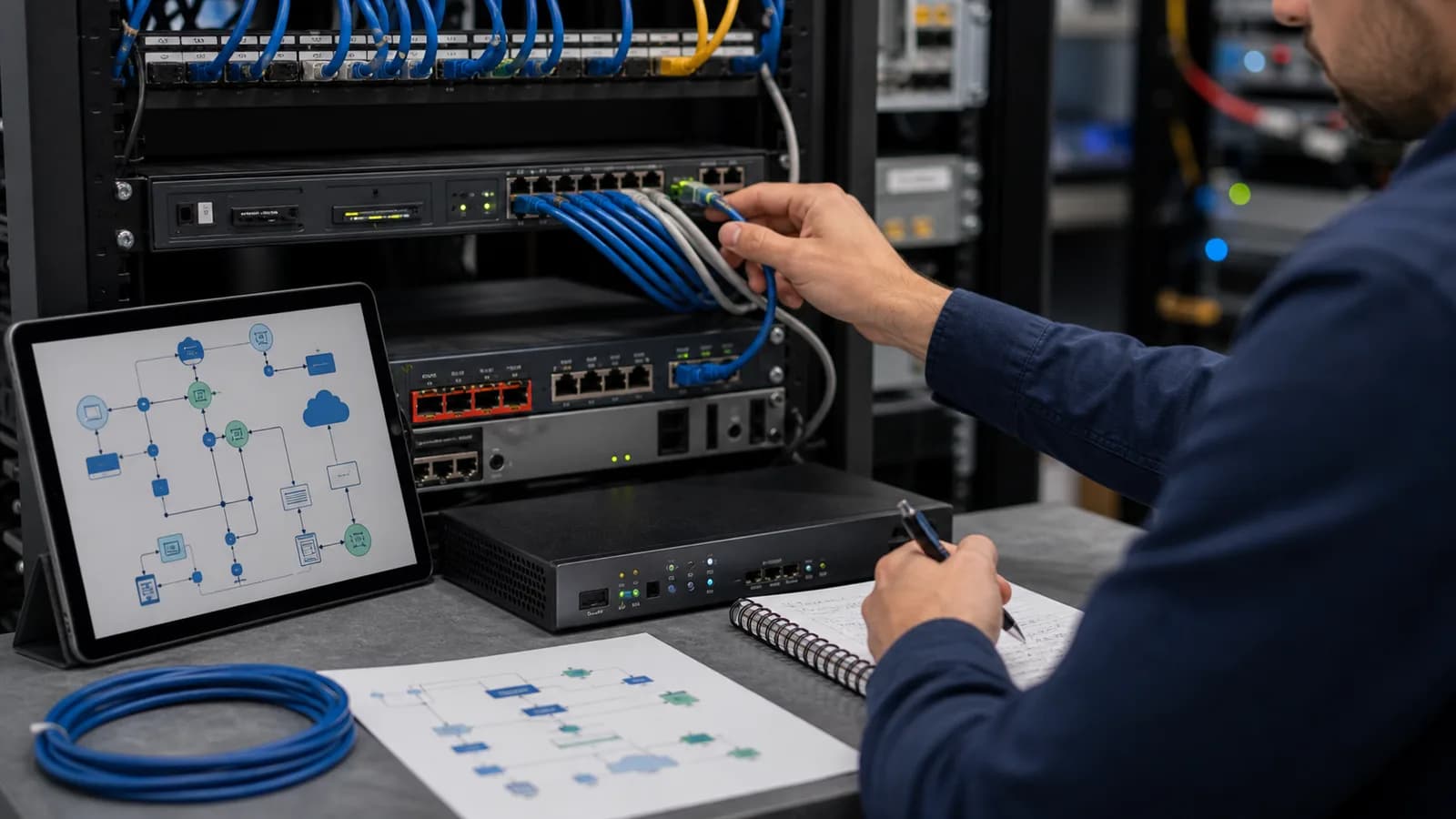
Infrastructure work needs a clear path from design to handover. This model connects firewall, routing, switching, servers, cloud links, endpoints, monitoring, and documentation into one delivery view.
Topology view
Firewall, ISP handoff, VPN, and routing policy.
Switching, VLANs, wireless, and segmentation.
Servers, storage, cloud links, and identity services.
Users, devices, printers, access, and remote paths.
The topology view is designed to make design assumptions, traffic paths, and ownership clear before hardware, firewall, or switching work begins.
Implementation path
Design baseline
Confirm routing, switching, access, and dependencies.
Configure and test
Apply changes in controlled windows with rollback paths.
Monitor and document
Capture diagrams, monitoring points, and handover notes.
Health checks
Latency
Tracked after handover
Uptime
Tracked after handover
Config
Tracked after handover
Access
Tracked after handover
/ Operational view
Start with the systems and risks in scope, agree access and change controls, then track remediation and review the results.
01
Signal
Purpose-designed network architecture eliminates bottlenecks, optimizes traffic flow, and ensures bandwidth is allocated to the applications and users that need it most.
02
Control
VLAN segmentation, managed firewall policies, IDS/IPS, DNS filtering, and Zero Trust principles are incorporated into the network design, not retrofitted after the fact.
03
Response
Network architecture design with topology diagrams, bill of materials, VLAN plan, IP addressing scheme, security zone definition, and implementation timeline. Reviewed and approved before procurement begins.
04
Evidence
Complete documentation package: as-built diagrams, configuration exports, IP address register, and runbooks. Ongoing management or a support retainer is confirmed at handover.
/ Proof to review
Buyer-friendly samples and checklists make the delivery model easier to inspect before a call.
Systems, vendors, incidents, access, and reporting mapped to clear owners.
Open risks, mitigation status, severity, and next action tracked in one view.
Runbooks, diagrams, access notes, configuration records, and escalation paths.
/ Ownership model
A quieter, inspectable model for what gets reviewed, managed, reported, and handed over.
Configured around the systems, identities, and risks that matter most.
Escalation routes and response windows confirmed after discovery.
Policy baselines, evidence records, and recurring review cadence.
Prioritized fixes with ownership, status, and next action tracking.
/ Risk matrix
These are the operational signals that usually mean the risk is no longer theoretical.
Network bottlenecks, Wi-Fi dead zones, and bandwidth saturation directly reduce output across your team. Slow infrastructure is a business problem that compounds every day it goes unaddressed.
If your network exists only in one person's head, that's a single point of failure. Undocumented infrastructure makes troubleshooting slower, security audits harder, and staff transitions expensive.
An unsegmented network means a breach anywhere (a compromised laptop, a guest device, a printer) can reach everything. Without VLAN segmentation, malware spreads laterally without restriction.
End-of-life equipment receives no firmware security patches. Running unsupported hardware is both a performance liability and a compliance issue, particularly in regulated industries.
/ Buyer outcomes
A serious infrastructure & networking partner should make scope, ownership, evidence, and handoff visible.
Purpose-designed network architecture eliminates bottlenecks, optimizes traffic flow, and ensures bandwidth is allocated to the applications and users that need it most.
VLAN segmentation, managed firewall policies, IDS/IPS, DNS filtering, and Zero Trust principles are incorporated into the network design, not retrofitted after the fact.
Redundant uplinks, failover configurations, and spanning tree tuning ensure your network continues operating when individual components fail.
Wi-Fi 6/6E deployments with proper RF planning, controller-based management, fast roaming, and guest network isolation. Not just access points plugged into a switch.
/ Scope map
The practical work BPro Technologies can own, document, and report for infrastructure & networking.
Complete network design with documented logical and physical topology, IP addressing plan, VLAN structure, routing policies, redundancy design, and security zone definition. Designed for your current needs and your next 3 years of growth.
Deployment and configuration of core and distribution switching (Cisco, Juniper, HP/Aruba), WAN connectivity (MPLS, internet broadband, SD-WAN), BGP/OSPF routing, and inter-site VPN tunnels.
Software-defined WAN for multi-site businesses: centralised management, application-aware traffic steering, automatic WAN failover, and cost reduction compared to traditional MPLS circuits.
RF site surveys, coverage planning, access point deployment and configuration, controller setup (on-premise or cloud-managed), guest SSID with captive portal, and fast inter-AP roaming.
Configuration, policy management, and ongoing monitoring of enterprise firewalls (Fortinet FortiGate, Palo Alto Networks, Cisco Firepower). Includes rule-base reviews, IPS signature updates, and SSL inspection tuning.
Remote configuration and management of server infrastructure: hypervisor setup (VMware vSphere, Microsoft Hyper-V), storage configuration (SAN/NAS), VM deployment and lifecycle management, performance monitoring, and capacity planning. We configure and manage your servers remotely through secure management interfaces, providing full visibility and control without the need for on-site presence.
Continuous monitoring of all network devices via SNMP, NetFlow analysis, and syslog aggregation. Alerts on interface errors, bandwidth saturation, device unavailability, BGP adjacency changes, and latency spikes.
Comprehensive, living documentation: logical and physical network diagrams (Visio or draw.io), IP address management (IPAM), device configuration backups, and step-by-step runbooks for common administrative tasks.
Design and testing of network failover configurations, backup ISP circuits, VPN contingency routes, and recovery procedures, so your network recovers from ISP or hardware failures within defined RTO targets.
/ Engagement terms
Clear boundaries help buyers compare infrastructure & networking without assuming every task, license, project, or access path is included by default.
Environment review, priority risks, monitoring approach, control gaps, and documented remediation path.
Response windows, access model, escalation owners, evidence cadence, and change approval rules.
Major licensing changes, hardware purchases, compliance audits, legal review, and emergency remediation outside the agreed scope.
Remote work uses named accounts, least-privilege access, MFA, approval paths, and documented escalation instead of shared or informal access.
Monitoring, logs, configuration records, asset notes, and reporting give the service enough visibility to support decisions and response.
Tell us the service area, current tools, users, business impact, and preferred contact window.
We identify the right next step: assessment, project review, co-managed support, or ongoing managed service.
Any system access, change window, or implementation work starts only after approval and documented scope.
/ Scope and pricing factors
Pricing is confirmed after scope, systems, access, coverage, and delivery expectations are understood. These factors help buyers compare options without relying on assumptions.
Decision preview
Users, devices, cloud tenants, servers, networks, firewalls, backups, and admin roles affect the review and support scope.
Identity exposure, endpoint gaps, backup readiness, monitoring needs, and incident response expectations affect priority and effort.
Response targets, escalation paths, reporting cadence, and security evidence are confirmed by scope and agreement.
A free assessment helps confirm whether the next step is remediation, monitoring, cloud governance, or ongoing support.
/ Delivery timeline
A delivery path with defined evidence, decisions, and handoff points at every stage.
Logical assessment of your current infrastructure using remote access, existing documentation, and structured discovery sessions with your team: network topology, device inventory, VLAN configuration, bandwidth utilisation, coverage gaps, and documentation quality. We produce a detailed findings report before any design work begins.
Network architecture design with topology diagrams, bill of materials, VLAN plan, IP addressing scheme, security zone definition, and implementation timeline. Reviewed and approved before procurement begins.
Remote configuration, validation, and change support during agreed maintenance windows. Physical rack, cable, and install work remains with your team or chosen local provider. We test routing, firewall policies, wireless configuration, and failover behaviour before handover.
Complete documentation package: as-built diagrams, configuration exports, IP address register, and runbooks. Ongoing management or a support retainer is confirmed at handover.
/ Buyer scenarios
Best-fit teams, environments, and business contexts for this service.
Scenario 01
Unified network management across multiple locations with SD-WAN for application-aware routing, centralized firewall policy management, and consistent security posture across every site.
Scenario 02
HIPAA-aligned network segmentation separating clinical systems, administrative networks, medical IoT devices, and guest Wi-Fi, with detailed access control policies at each boundary.
Scenario 03
Industrial-grade wireless infrastructure for production floor environments, barcode scanners, and mobile devices, designed for coverage, interference resistance, and roaming consistency across large facilities.
Scenario 04
Guest Wi-Fi with captive portal and bandwidth management, fully isolated from back-office and POS systems, with centralized management and usage reporting across properties.
We work with all major enterprise networking vendors including Cisco, Juniper, HP/Aruba, Fortinet, Palo Alto Networks, Ubiquiti, and Cisco Meraki. We recommend the right vendor based on your budget, scale, existing investment, and support requirements. We're not incentivised by any single manufacturer. If you have existing equipment, we work with it. If you're refreshing, we'll recommend what's right for your use case.
SD-WAN (Software-Defined Wide Area Network) centralizes control of your WAN connectivity and allows intelligent, application-aware routing of traffic across multiple links (broadband, MPLS, 4G/5G). It's particularly valuable for businesses with multiple offices, significant cloud usage, and remote workforces. SD-WAN typically reduces WAN costs compared to traditional MPLS while improving performance and resilience through active-active failover. If you have more than two sites or a cloud-heavy application stack, it's worth a serious evaluation.
Network segmentation divides your network into isolated zones using VLANs and firewall rules enforced at each boundary. This limits the blast radius of a security incident: if malware compromises one segment, it cannot automatically reach servers, databases, or other segments. It also lets you enforce different security policies for different device types: a connected printer should not be able to communicate with your file servers. Segmentation is a foundational control in Zero Trust architecture.
A single-site remote network refresh typically takes 3 to 7 business days once equipment and access are ready, including planning, configuration, testing, and documentation. Multi-site projects are delivered in phased waves to minimise business disruption. When physical install work is needed, we provide the configuration plan and handoff notes so your team or chosen local provider can complete the onsite portion cleanly.
Documentation is a standard deliverable on every infrastructure project, not an optional extra. You receive logical network diagrams, an IP addressing register, VLAN definitions, firewall rule documentation, configuration exports, and step-by-step runbooks for common administrative procedures. Physical diagrams or coverage notes can be included when your team or local provider supplies the site details.
Yes, ongoing network management is available after any infrastructure project. This covers device monitoring and alerting according to the agreed coverage model, firmware and patch management, firewall rule reviews, monthly bandwidth and availability reporting, configuration backup, and handling all changes through a structured change management process. Many clients move from a project engagement to an ongoing managed service after initial infrastructure delivery.
Slow networks usually come from a few causes: undersized or aging hardware, poor Wi-Fi coverage and channel interference, misconfigured QoS, saturated internet links, or no traffic prioritization for cloud apps and calls. Most diagnosis and configuration is done remotely. We review your devices, configuration, and traffic, then recommend fixes; any physical work like cabling or access-point placement is documented for your chosen onsite resource.
A network assessment is a structured review of your current infrastructure: device inventory and firmware status, network topology, Wi-Fi coverage, firewall and security configuration, bandwidth use, and single points of failure. You receive a written report with prioritized findings and a remediation plan. It is the recommended first step before any upgrade, so spending targets the problems that actually matter.
SD-WAN optimizes how traffic routes across your network connections. SASE bundles that routing with security functions like a firewall and access control into a single cloud-delivered service. Most new deployments now combine the two rather than buying them separately. We size the right combination against your site count and security needs rather than defaulting to one.
Yes. Multi-site connectivity is scoped around your locations, bandwidth needs, and failover requirements, with centralized management so policy and monitoring stay consistent across every site rather than configured separately per office.
Both are available. Firewalls can be configured as a one-time project, or included in ongoing management with rule reviews, firmware updates, and monitoring as part of infrastructure support. We confirm which fits during scoping.
Yes, depending on what's being accessed. Lighter-weight zero-trust access options can grant scoped access to specific applications without a full VPN tunnel to the whole network, which we can evaluate against your existing setup.
A managed firewall service keeps your firewall configured, patched and watched so it keeps protecting the network as things change. That usually covers firmware updates, rule reviews to remove old or overly broad access, VPN and remote-access settings, alerting on unusual traffic, configuration backups and a change log. BPro Technologies manages these remotely and documents every rule change with a reason and an approver.
Yes. BPro Technologies delivers remote services for businesses in the United States and United Kingdom. Every managed client receives 24/7 monitoring and helpdesk. Before work begins, we agree the systems in scope, response targets, and escalation contacts. Project and co-managed engagements have their own agreed scope. Physical work is handled by your team or chosen local provider.
Yes. Most work is delivered through secure remote access, approved admin accounts, ticketing, monitoring, documentation, scheduled calls, and defined escalation paths. If a task needs hands-on work, BPro Technologies documents the requirement so the client can use their own team or chosen local provider.
No. The first conversation can start with business context, current tools, users, risks, and goals. If deeper technical review is needed later, access is requested only after approval and is limited to the agreed scope.
BPro Technologies reviews the request, confirms the service area, asks for any missing context, and recommends the next step. That may be a free assessment, a fixed-scope project review, a support plan, or a more detailed discovery call.
Remote delivery relies on MFA, named accounts, least-privilege access, audit trails, documented change paths, and clear approval rules. The goal is to make access and decisions visible rather than informal.
/ Next step
We'll assess your current infrastructure, identify performance and security gaps, and produce a clear remediation or upgrade plan with realistic timelines and costs.
No commitment required - We usually respond within one business day